I am an MSCA Postdoctoral fellow at TU Delft with a deep interest in understanding the best way to make things move.
I particularly enjoy working on nonlinear control and applying it to soft robots, which is what my MSCA project Soft-Scout is all about.
News
Updates about my research activities.
Research
Soft-Scout: Controlling Soft Robots in Confined Spaces
Soft-Scout focuses on controlling soft robots for advanced adaptivity and versatility in confined spaces,
enabling safer and more precise inspection and maintenance in demanding environments.
Project overview
Access to confined spaces is highly crucial, whether for repairing hard-to-reach aircraft
engine parts, performing minimally invasive surgeries, or inspecting infrastructure after
severe weather events.
The Soft-Scout project (Controlling Soft Robots for Advanced Adaptivity and
Versatility in Confined Spaces) addresses these challenges by enabling a soft-bodied robot
to autonomously navigate and accurately conduct tasks within confined areas. This leads to
reduced human effort and improved quality of inspection and maintenance.
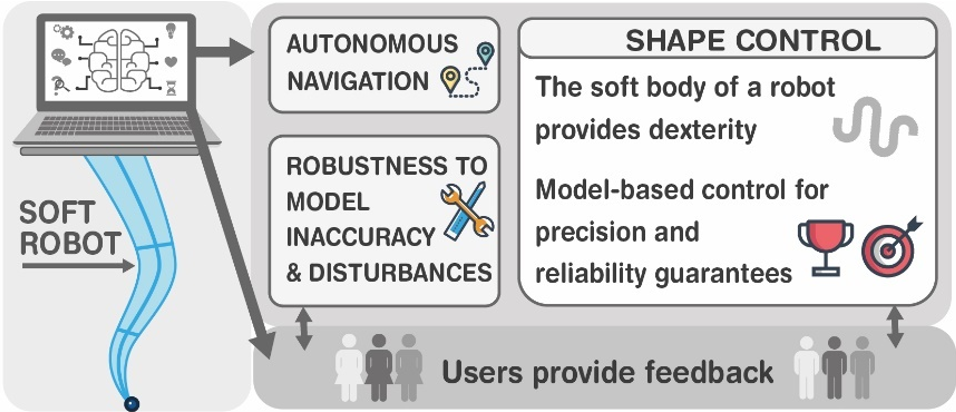
To address the complexity of soft robotic systems, the overarching objective of Soft-Scout
is to develop and deploy control and learning frameworks that provide guarantees
on precision and reliability, while equipping the robot with the autonomy and robustness
needed to navigate unknown confined areas.
Concept of Soft-Scout.
Objectives
Objective 1
Develop an advanced shape control framework that enables a soft robot to perform
various tasks in confined spaces with guaranteed precision.
Objective 2
Design a twofold learning strategy for autonomous navigation and robustness, allowing
the robot to cope with uncertainties in real-world environments.
Objective 3
Experimentally validate the control and learning framework on a tentacle-shaped soft
robot and integrate feedback from end users.
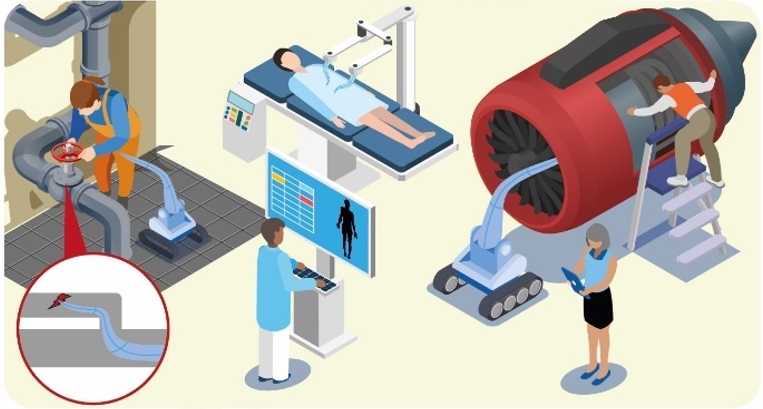
Potential use cases of Soft-Scout solutions: maintenance and inspection of aircraft engine, minimally invasive surgery, or infrastructure inspection.
Impact and alignment
Compared to state-of-the-art rigid solutions, the elasticity of a soft robot’s body enables
inherently safer navigation through confined areas, while the proposed framework supports
robust and dexterous operation with clear precision and reliability margins.
Soft-Scout is aligned with the United Nations Sustainable Development Goals and
European priorities, including the European Strategic Agenda and the Horizon Europe
Missions, by addressing safer inspection, maintenance, and intervention in critical
infrastructures and industrial systems.
Project facts
Project: Soft-Scout
Role: MSCA Postdoctoral Fellow
Researcher: Maja Trumić
Supervisor: Dr. Cosimo Della Santina
Host: Delft University of Technology
Location: Delft, The Netherlands
Funding: Marie Skłodowska-Curie Postdoctoral Fellowship
Research on soft robot control within the MSCA PF project Soft-Scout.
November 2025 - now
Research Associate
University of Belgrade - ETF Robotics
Conducting research on soft robotics and dynamic manipulation. Serving as a technical coordinator for the Horizon Europe project MUSAE. Task leader for the national project CircuBot.
September 2021 - October 2025
Visiting researcher
TU Delft and RoboHouse
Developing the control strategy for trajectory tracking for soft robots.
January 2023 - March 2023
Ph.D. student
University of Palermo - MIRPA Lab
Developing the algorithms for low-cost stiffness estimation and nonlinear adaptive control for soft robots.
November 2017 - September 2021
M.Sc. student intern
Robert Bosch GmbH in Buehl, Germany
Developing and testing wavelet-based algorithms for faults detection in DC motors.
April 2017 - October 2017
Bachelor student intern
Robert Bosch GmbH in Renningen, Germany
Analyzing the test systems for DC motors.
June 2016 - September 2016
Education
University of Palermo and University of Belgrade
Ph.D. in Robotics and Automation
My Ph.D. thesis ''Stiffness estimation and adaptive control for soft robots'' focused on enabling the effective performance of soft robots even in cases when knowledge about the robot’s parameters and environment is lacking. I worked on developing low-cost solutions for sensing robot’s stiffness and on the adaptive control theory, especially investigating novel algorithms that achieve simultaneous control of robot's position and compliance. I worked under the national-funded research project ForNextCobot regarding bioinspired robot control, obtaining several journal and conference papers.
November 2017 - September 2021
University of Belgrade - School of Electrical Engineering
M.Sc.
Signals and systems department with the main focus on system control and signal processing.
October 2016 - September 2017
University of Belgrade - School of Electrical Engineering